
beesa league rules
redlines by board in red
Quick highlight reference
- Rec (Mixed, Open B and C) leagues: 7 run limit per half inning in innings 1-4. (see rule 7)
- Home run limit
- Open C and Mixed Rec. = 1 home run/game/team + progression
- Open B= 2 home run/game/team + progression
- Open competitive = 3 home run/game/team + progression
(see rule 5)
- Batters start with 1-1 count and get one courtesy foul per at bat. (see rule 6.A)
- Game time limits:
- Regular Season: No new inning after @ 60 mins / Game ends @ 70 mins
- Playoffs: Game ends @ 70 minutes (see Rule 3.A for exceptions)
Gameday playing rules
1. lineups
Mixed Leagues Only
A. The on-field line-up shall be seven men and three women. There may be more than three women but never more than seven men in the on-field line-up at one time. No more than 5 consecutive male batters can come to the plate at any time
B. No team will be allowed to play with fewer than 2 women. If a team plays with only 2 women, they may choose to play with 8 players total (in the field and in the batting order) or 9 players (in the field). If the team chooses to play with 9 players in the field, they must take a dead-ball out in any dedicated position (1 through 10) of the batting order where the missing female player would have batted had she been in attendance. More than 9 players can be in the batting order, provided that rule 1.A is met
i. If a team has 10 or more players, they must play 7 men and 3 women in the field at all times, and there must be at least three female batters in the first 10 positions of the batting order.
ii. These limits represent a minimum number of women and a maximum number of men. An increased female-to-male ratio is allowed
iii. Failure to meet these line-up criteria will result in forfeiture of game
iv. There is no restriction on where in the field women must play. As long as the required ratio of male to female players exists, the females can play any position
C. At no time will a team be allowed to play with fewer than 8 players.
D. Each manager has the option of batting as many as they want in any order on offense (providing rule 4.A is met). Players must be in the batting order to play defense.
E. Changes to the batting order
i. Players who must leave during the game will be skipped in the batting order, except when in violation of Rule 1.A, or in case of player ejection. Ejected players will result in an automatic dead-ball out in their position each time through the lineup.
ii. Full substitutions can be made during the game (one player completely removed from the batting order and replaced by another player from the roster that is not already playing). If this occurs the umpire and opposing manager must be notified at the time of the substitution. The player going into the game must bat in the same place in the batting order as the player that was removed. A player that is removed may not re-enter the game except at the umpire’s discretion to replace an injured player that is unable to continue.
iii. Substitutions that will result in a violation of Rule 1.A will not be allowed
2. regulation games
B. No new inning @ 60 min (game is complete @ 70 min) – If you do not finish the inning due to the time limit then Rule 2.C will be enforced.
C. If a game is stopped due to time (@ 70 minutes)....
i. And the home team is ahead or tied at the time the game is stopped, the score will stand.
ii. And the visiting team is ahead at the time the game is stopped, the score reverts to the last full inning.
E. If a team cannot field at least eight players 10 minutes and one second after the scheduled start time of any game, they shall forfeit the game.
G. If a team has a minimum number of players at game time, they must start the game.
H. A manager may appeal a forfeit due to a lack of players if they can prove that they could not field a team due to illness, overtime work, or company business
I. Forfeit by one or both teams will constitute a played regulation game, designated by a 7-0 score (in the event one team forfeits to the other) or a 7-7 score (in the event of a double-forfeit, with both teams recording a loss).
J. Rain postponements will be determined no later than 2:30 p.m. on the day of the scheduled game.
i. Team captains will be notified in the group text thread for that night
ii. Postponements due to unfit field conditions immediately prior to or during the
game will be determined solely by the umpire
iii. If the first game is postponed, all games are postponed
iv. Weekend games, if there are any, will be postponed on a game-by-game basis, as determined by the umpire
v. All rainouts will be rescheduled by BEESA. This may require extending the season or adding doubleheaders where not previously scheduled. BEESA reserves the right to update the schedule as necessary without prior notification of the teams involved.
3. Playoff games
i. If no winner is decided by 70 minutes past the scheduled start time and all environmental and safety conditions allow safe play, and does not encroach into another playoff game, the game will continue until a winner is determined.
ii. If no winner is decided when safe conditions are not present (darkness, weather, encroachment into another playoff game, the game will be decided by a coin flip presided over by the umpire as outlined in USSSA International Tie-Breaker rule.
4. Bats and balls
i. Wood bats that have the words “Softball” or “Official Softball” are allowed and do not require the USSSA stamp to be on them.
C. ASA / USA Softball -only bats will NOT be allowed, unless it is a wood bat per 4.A.I. Only approved USSSA/BEESA softball bats are allowed. (Dual stamp USA / USSSA bats are allowed)
D. Any player caught using a non-approved bat, even to warm up in the on-deck circle, will be declared out, and will be ejected from the game. The ejected player’s designated place in the line-up will result in a dead-ball out for the remainder of the game.
E. Balls: The game ball used by the league is the Baden Fire USSSA Classic M ball. If teams purchase additional backup balls, they must be this model to be used in games.
5. home runs
i. Assisted home runs - Batted balls that contact a defensive player or their glove, prior to touching the ground, and then travel over the fence will be treated as a home run. Assisted home runs will not count towards the home run limit in Rule 5.B
ii. If contact is made by a fielder and judged by the umpire that the ball would not have gone over the fence without touching the fielder, that ball will not count to the home run limit. If a fielder contacts a ball that the umpire deems would have gone over the fence without contact (attempt to “rob” home run), that home run will count towards the home run limit.
iii. The team that hit the home run shall retrieve the ball and provide back to the umpire or provide a “backup” ball to the umpire to replace that ball for game play.
The league uses a Progressive Home Run rule. Each team is allowed a limited number of over-the-fence home runs per game. Balls hit over the fence in fair territory in excess of the limit will be a dead-ball out that ends that half of the inning for the balance of that game. Runners may not advance and no run penalty will be enforced
The following are the limits per league:
i. Open C (recreational) = 1 home run/game/team + progression (see below)
ii. Open B (intermediate) = 2 home run/game/team + progression (see below)
iii. Open A (competitive) = 3 home run/game/team + progression (see below)
iv. Mixed Recreational league = 1 home run/game/team + progression (see below)
Once both teams have reached their over-the-fence home run limits as described above in 5.B.I-III, each team can hit additional home runs, but shall never be more than one home run ahead of their opponent.
v. Note that this is still applicable in the final inning due to complications that would arise with not allowing the home to go ahead in home runs in the last inning with games that revert.
6. Misc. Gameplay rules (at-bats, baserunning, fielding)
All batters will start with a 1 and 1 count (1 ball and 1 strike) and an available courtesy foul (courtesy foul example in section 10.S).
Whether intentional or not, will result in just a one-base award for all players in all situations, regardless of gender or league played in. In mixed league, women batters must hit even if the previous male batter was walked
C. Base Running
i. No stealing is allowed in any division of play.
ii. Courtesy runners are allowed at any time, at the umpire’s discretion. The courtesy runner must be the last player of the same gender to make an out in the game. Note: if captains agree to use USSSA courtesy runner rules, they must be followed entirely. See USSSA Rule 8, section 13:
If the courtesy runner is still on base at the time her/her turn at bat comes up, that spot in the batting order will be an out. In the Mixed Program, any male player on the roster may run for any male, and any female player on the roster may run for any female. Both a male and female player may opt for a courtesy runner in each inning.
NOTE: Any player removed due to injury is ineligible to return to the same game.
ii. A dead ball out is called when a batted ball is a line-drive hit directly into the Halo Zone. All runners will return to their previous base.
iii. The Halo Zone is an imaginary box extending 1 foot from each side of the pitching rubber, and from the ground to 1 foot above the pitcher’s head. See the image below:
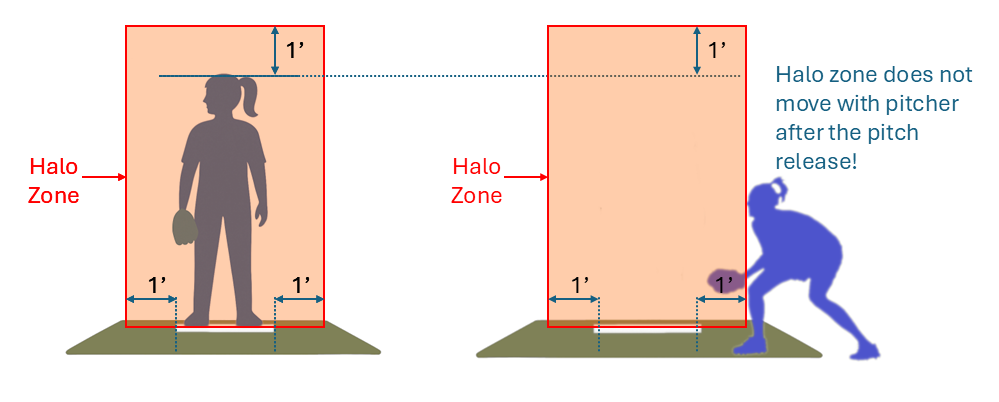

v. The Halo Zone does not follow the pitcher. If they move out of the zone after delivering a pitch they are offered no protection.
vi. If the pitcher moves away from the Halo Zone after the pitch is delivered, and a line-drive hit travels through the Halo Zone, it is still an out.
vii. If the same batter is called for Halo infraction twice in a game that player will receive an offensive ejection
ix. This rule is not up for interpretation of the players, and players shall not argue the call with the umpire. It is solely on the judgment and discretion of the umpire.
Applies to mixed leagues only: Female batters have the option to request a 12-inch ball for their turn at bat. The batter must request the 12-inch ball prior to entering the batter's box. If no request is made, the female batter will be pitched the 11-inch ball. The ball cannot be switched for a different size ball during the female's turn at bat once the request (or no request) has been made. If the pitcher pitches the 11-inch ball to a male batter, it counts as a legal play and the 11-inch ball will be switched for a 12-inch ball at the next dead ball.
7. Run Rule & Flip flop rule
For Rec Divisions (Open B and C and Mixed), there will be a maximum of 7 runs allowed in either half of an inning up to the 4th inning. Once a team reaches 7 runs in innings 1 through 4, their offensive half of the inning shall end, regardless of outs or runners left on base. There will be no limitation for the number of runs either team may score in innings 5 through 7.
The implementation of the flip/flop rule defined in the USSSA rule book, modified below, is allowed. This is optional, and both teams must agree to it at the start of the last inning of play.
inning.
8. Field regulations
B. The field of play is defined as the area between imaginary extensions of the backstop fence, all the way to the outfield fence, parallel to the foul lines. Any ball that crosses one of these lines is out of play. Any ball that travels over the outfield fence or backstop fence is out of play. Batted balls that travel over the outfield fence without touching the ground are subject to the home run rule (Rule 5).
C. No practice will be allowed on the infield dirt prior to the start of any scheduled game.
D. Applies to mixed leagues only: a 170-foot arc will be enforced such that no more than six fielders may be inside the arc prior to the pitch. All other fielders must remain outside the arc until the pitch has passed home plate or is batted.
F. No alcoholic beverages are allowed at the playing fields. Violation of this rule will result in forfeiture of the game, possible suspension of players and appropriate disciplinary measures from TBC.
G. No tobacco use of any kind is allowed anywhere on Boeing property (this includes vaping devices and e-cigarettes).
H. Players are encouraged, but not required, to wear a jersey that is similar in style and color to those of their teammates.
I. Cleats must be made of molded plastic and one-piece sole. No screw-in or metal cleats of any type are allowed. If unacceptable cleats are found, the umpire will ask the player to remove them. If the player refuses, they may be ejected from the game or the game may be forfeited, at the umpire’s discretion
9. Other game day rules
B. The substitute may be a spectator or member of either team
ii. The substitute must sign an official scorebook and provide contact information after the conclusion of the game.
iii. Substitute umpires must be at least 18 years of age.
tolerated. Violations of this rule could result in player suspension.
D. BEESA utilizes the Boeing Everett Activities Center Softball Fields. These are Boeing owned fields and are located on Boeing owned property. This means that all Boeing rules apply (this includes parking lot areas). Boeing employees may be held accountable for the actions of their non-Boeing employee guests.
Boeing policy includes the following rules (but are not limited to):
ii. No alcohol or drugs (Drug and Alcohol Free Workplace Program / PRO-388)
iii. No Tobacco use (Tobacco Free Workplace / PRO-6403). This includes vaping devices and e-cigarettes.
general league rules and player eligibility
10. Player Elgibility
B. Boeing Retirees
C. Employees on company layoff less than 30 days before first day of scheduled play will be eligible for the current season only. Any season after would be considered an Associate player and will need to fill out an application.
D. Company termination, other than layoff or retirement, automatically cancels the player's league membership.
E. Spouses and/or dependents (16 years of age or older) of Boeing employees are eligible to play but must play on the same team as the employee and must sign the team roster. (Spouses and Dependents do not need to apply as an associate member)
F. BEESA League is allowed up to 20% total Associate Membership. See BEESA website for Associate Membership details and application form
ii. Associate Members are defined as individuals who voluntarily terminated their employment with The Boeing Company (TBC)
iii. Individuals who were previously employed by TBC, and were terminated because of a reduction in force are eligible to play as Associate Members
iv. A formal application is required (Associate Member form). That form must be turned in to the BEESA board and approved by the Boeing Recreation Department. Associate Members must abide by all BEESA rules, regulations, and bylaws, or will be removed from the BEESA league permanently. If there are any questions on Associate Members, email the BEESA Executive board members at DL BEESA Board Members
H. Players may be on multiple team rosters; however, a player cannot be on rosters for two or more teams in the same division on the same night. Essentially, players may not play on multiple teams that may play each other as part of the regular season schedule.
I. A coach is considered a member of a team.
J. Any use of a player not eligible under these rules will result in forfeiture of all team games played while ineligible.
K. Players may be ruled ineligible by BEESA for rule infractions or gross misconduct.
11. team rosters
B. Team rosters will be maintained by the league secretary as appointed by the Executive Board.
C. Players may be added later but are not eligible to play until the board has been notified.
D. There is no limit to the number of players on a team roster.
E. A player may transfer from one team to another prior to completion of six regular- season games when both coaches agree and it is verified by the Executive Board.
ii. A player may make only one team transfer per season
12. scorekeeping, standings, and playoffs
B. Both team managers are responsible for ensuring game scores are reported to the BEESA website. The WINNING team is responsible for inputting the score on the next regular workday. The LOSING team is responsible for verifying the score was reported correctly. When a tie occurs the HOME team is responsible. If no score is turned in by the next scheduled game for either team, the game will be listed as a double forfeit.
C. All scores and league standings will be recorded on the BEESA website.
D. Final league standings will be determined by ranking each team with respect to season points (2 points for each win, 1 point for each tie, 0 points for each loss). The following tie breakers will be applied for playoff seeding in this order:
ii. Run differential in head-to-head match-ups will be the second tie-breaker
iii. Run differential over entire season will be the third tie-breaker
i. In leagues of 7 or fewer teams, the top 4 teams will advance to the playoffs, unless stated otherwise on the schedule for that season.
ii. In leagues of 8 through 11 teams, the top 6 teams will advance to the playoffs, unless stated otherwise on the schedule for that season.
iii. In leagues of 12 or more teams, BEESA will make a special determination at the start of the season as to how many teams will advance to the playoffs
iv. In the event of a tie in points between teams for playoff position(s), the tie- breaker criteria will be used to determine which team(s) advance to the playoffs (see rule 12.D.I,II,III)
13. FORMAL PROTESTS / APPEAL PROCESS
ii. A written letter of protest must be submitted to the Executive Board by the protesting manager. This letter will include the name of both teams, the date of the game and the field it was played on, the umpire involved, and the rule claimed to have been misinterpreted
iii. The protest must be accompanied by a $25.00 check made payable to BEESA. This filing fee will be returned if the protest is upheld, or forfeited to BEESA if the protest is denied
iv. The protest will be heard by the Executive Board within one week of the game and they shall present their decision the day following the review
C. Protest will be heard by the Executive Board as early as possible and should be prior to the next game to be played by the team alleged to be in violation.
14. division reclassification
A. BUMP UP rule: Must meet two of the following three criteria to be bumped up:ii. Winning percentage equal to or greater than .750 during regular season
iii. Run differential of 75% or below during regular season (RA/RF)
*The BEESA Board may place teams at their discretion for player safety and the
ii. Winning percentage less than or equal to .250 of total games played
iii. Run differential of 150% or above (RA/RF)
*The BEESA Board may place teams at their discretion for player safety and the health of the league
15. Miscellaneous
B. No special insurance is provided for injuries that may occur while participating in BEESA activities. Your regular company health insurance covers such injuries, etc., subject to the respective plan.
C. At no time shall a tournament or award be given with any references to the BEESA except those authorized by BEESA.
D. All players, coaches, and managers are responsible for being familiar with USSSA and BEESA playing rules.
E. Outside sponsorship of teams that are participating in any BEESA league is not allowed.
F. During play, all dangling or potentially entangling jewelry and watches must be secured to the body and covered, or removed prior to play. This includes, but is not limited to, necklaces, earrings (other than small “stud” earrings), and large rings or rings with prominent raised settings and watches. The umpire may request that any jewelry be emoved (not just covered) if he or she feels it causes a potential safety risk.
____________________________________________________________________
Rules References
Strike zone
Sec. 4. A STRIKE IS CALLED BY THE UMPIRE:
A. For each fairly delivered pitched ball by the pitcher that passes through the strike zone before touching the ground.
C. For a batted ball striking the batter, while he is in the batter’s box with no strikes.
D. For each foul tip. [redacted due to BEESA rule presidence]
E. For a foul ball not caught on the fly with no strikes.
F. The umpire shall not give a call or signal for “TIME” when a batter steps out of position after a pitcher has started his delivery motions.
PITCHING
Sec. 6. TYPE OF PITCH PERMITTED.
A. The ball must be pitched in a definite underhanded motion at slow speed.
B. The pitched ball must arc at least 3 feet after leaving the pitcher’s hand and before it passes any part of home plate.
C. The pitched ball shall not rise higher than 10 feet above the ground.
EFFECT Sec. 6. A-C. The speed of the pitch and height of the pitched ball are left entirely to the judgment of the umpire (NOTE: For sake of uniformity in decisions, any doubtful pitch should be ruled as an unfairly delivered pitch). The umpire shall warn a pitcher who delivers a pitch with EXCESSIVE SPEED that repeating such EXCESSIVE SPEED PITCH will cause the pitcher’s removal from the pitcher’s position for the remainder of the game. A pitch that does not arc the full 3 feet as required (flat level pitch) may not be an EXCESSIVE SPEED PITCH, but merely an unfairly delivered pitch.